The trading journal funded-account traders actually need.
Generic journals weren't built for what you do. You run 3 prop firms in parallel. You blow Evals because of emotion, not bad setups. You're not just tracking PnL — you're managing rule-distance, drawdown-distance, and the psychological gap between Eval and Funded. GridTrade is the journal built around that reality.
Free · no credit card · no subscription
5 things this journal does that others don't
1. Multi-account is native — not a Pro/Premium gate
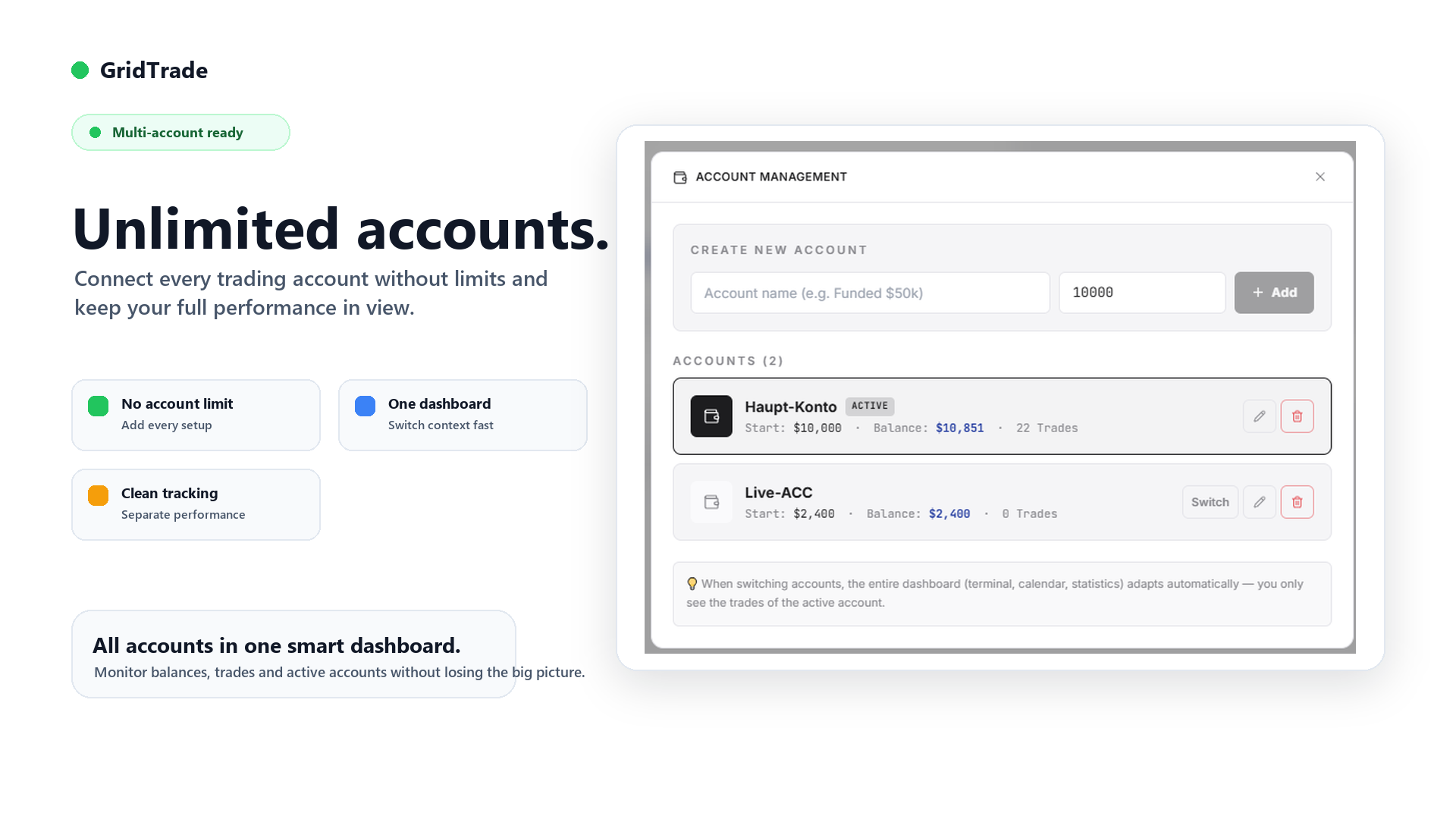
Run an FTMO 100k Challenge, two Apex 50k Evals, a Topstep Combine, and your live brokerage account — all five accounts in one journal, one click to switch between them, unified analytics across all of them. No "upgrade to Pro for multi-account" tax. It's in the base tier.
2. Daily-PnL calendar — see drawdown distance at a glance
Every prop firm has a daily-loss limit (FTMO 5%, Topstep ~4%, Apex trailing). The calendar view colors each day green/red/grey per account, so you can see at a glance how close you came to breaching today, this week, this month. The red-streak visualization makes drawdown patterns inescapable.
3. Emotion 1-5 as a structured field — quantify the leak
The data most funded-account traders refuse to look at: their win rate at emotion 4-5 vs 1-2. GridTrade makes that visible. Tag every trade with emotion 1-5. Filter by emotion state. Most traders see a 20-30% drop in win rate at high emotion. That's the leak that fails Challenges.
4. Setup playbook with live expectancy per setup
Define the setups you actually trade. Tag every trade with one. GridTrade computes live win-rate and expectancy per setup. Most traders discover 1-2 of their favorite setups are actually negative-expectancy — and cutting those is the fastest path to passing Challenges.
5. Mistakes catalog
Pre-built mistake tags: Revenge Trading, FOMO Entry, Stop Moved, Overtrading After Win, Setup Invalid But Took Anyway. Tag the trade once. The mistakes view shows which one is costing you the most R-multiple — across all your accounts, prop firms, and timeframes.
Prop-firm-specific journal pages
Each prop firm has different rules and pain points. We have a dedicated page per major firm:
For FTMO Challenge / Verification / Funded — daily 5% loss, 10% max, manual review.
For Apex Evals + PA accounts — trailing drawdown, up to 20 parallel Evals.
For Topstep Combine + Funded — daily loss limit, consistency rule.
FundingPips, FundedNext, E8, The5%ers and others — same setup, just add an account.
FAQ — funded-account journaling
You can — and many traders start there. The gap shows up around trade 50: filtering becomes painful, mistake patterns disappear in the noise, you can't easily ask "what's my win rate on NQ Mondays before 10am at emotion ≥ 4?" A purpose-built journal makes those queries one-click. For funded traders the spreadsheet breaks down faster, because you're not tracking one account — you're tracking several with different daily loss limits and drawdown types, and a formula error on the wrong cell can hide how close you are to breaching. Drawdown distance, challenge-vs-funded comparisons, and emotion logging all have to be built and maintained by hand, and they rarely survive a bad week when you least feel like updating a sheet. A dedicated journal keeps those views live automatically, so the analysis is there when you actually need it — during the debrief, not three months later when the account is already gone.
Hetzner servers in Frankfurt (Germany) and Supabase EU region. GDPR-compliant, row-level security per user (nobody but you reads your trades — not even us). Trade data exports as JSON/CSV anytime. For funded traders this matters more than usual: your journal holds a full record of how you trade across every prop firm, which strategies work under which rules, and where your discipline slips — the kind of history you don't want sitting in a random cloud tool with unclear ownership. Storing it in the EU under row-level security means each account's data is isolated at the database level, not just hidden behind a login. Because you can export the whole thing to JSON or CSV whenever you want, you're never locked in: if a prop firm shuts down or you switch tools, your multi-account history stays portable and yours, ready to carry into your next challenge or a fresh analysis somewhere else.
Yes — GridTrade is a PWA that installs on iOS and Android with full feature parity. Logging a trade while the emotion is still raw (within 5 minutes of close) is the single highest-value journaling habit. We optimized the mobile flow for that. This matters most on funded accounts, where the trades that breach rules are usually the emotional ones — the revenge entry after a stop-out, the oversized size-up when you feel behind on the payout target. If you wait until evening to log, that feeling has faded and you'll write a sanitized version that hides the real cause. Capturing the emotion score and a one-line note on your phone, at the desk, right after close, is what turns the journal into an early-warning system. Over weeks it shows you which emotional states precede your worst days on funded capital, so you can flatten or walk away before you hand the drawdown line back to the prop firm.
Currently manual — by design, the migration is a review pass on each trade (which is valuable). CSV import is on the roadmap for traders with 500+ historical trades. For funded traders the manual pass is worth more than it sounds: as you re-enter each trade you tag which account and rule set it belonged to, and you'll notice patterns that a bulk import would flatten — for instance that your challenge trades were disciplined but your funded ones drifted once payout money was live. That labeling is exactly the multi-account context GridTrade is built to analyze, so doing it by hand once seeds a cleaner journal than a raw dump ever would. If you're carrying hundreds of trades and don't need per-trade review, wait for the CSV import rather than grinding it out. See also our honest comparisons: vs Tradervue, vs Edgewonk, vs Tradezella.
Your trade data stays in your GridTrade account regardless — keeping the historical journal is one of the best ways to debrief and apply lessons to your next prop firm. Prop firms come and go, change their rules, or freeze payouts, and none of that touches the record of how you actually traded. Because each firm is just a separate account in your journal, a shutdown doesn't corrupt anything — you keep the full history of setups, emotion scores, and where you sat against that firm's drawdown line right up to the end. That's exactly the material you want when you start a new challenge somewhere else: you already know which strategies held up under pressure, which emotional states cost you, and what your real numbers look like across accounts. And since you can export everything to JSON or CSV at any time, your journal outlives any single firm — the data is yours to carry forward, not theirs to take offline.
Legal & Trademark Notice
Trademarks: “FTMO”, “Apex Trader Funding”, “Topstep”, “FundingPips” and other prop-firm names are trademarks of their respective owners. GridTrade is not affiliated with, endorsed by, sponsored by, or in any way officially connected to any of these companies. References are made under the right of comparative advertising (German UWG § 6 / EU Directive 2006/114/EC) to describe compatibility with their publicly known rules.
Disclaimer: GridTrade is a journal/analytics tool. It does not provide trading signals, financial advice, or guarantees of success in any prop firm program. Trading carries substantial risk. Always verify current prop-firm rules on the respective firm's official website before relying on any specific rule reference made on this page.
Last reviewed: 2026-05-22. · Operated by Fabian Lehmann (see Impressum).
Built around how funded-account traders actually work.
Free to use. No credit card, no subscription, all prop firms in one journal.
Continue reading
Related guides and pages — same niche, different angle.